Bioengineering Laboratory
Email: milyas@mgh.harvard.edu
Call: 617-726-1346
Overview
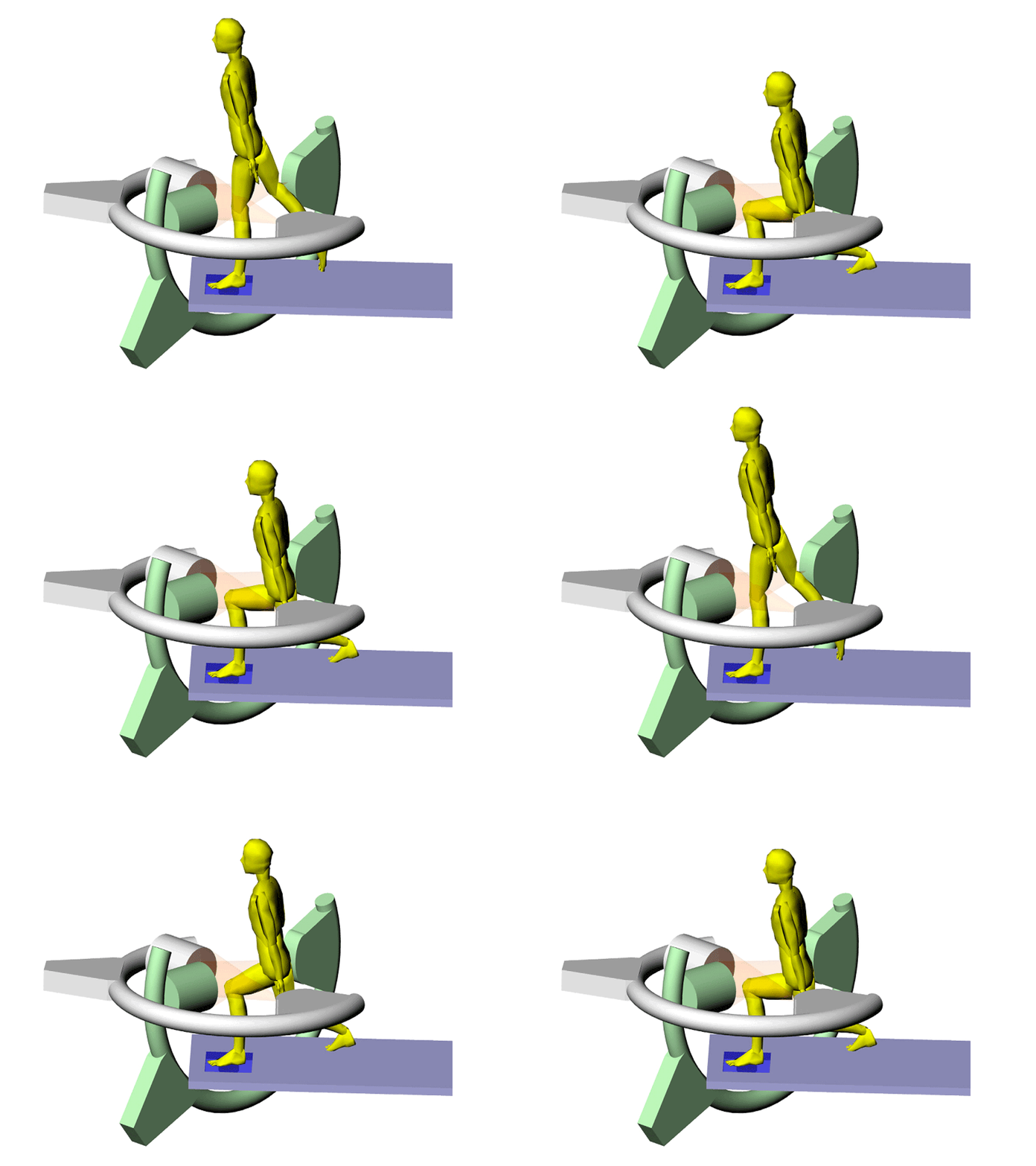
In vivo kinematic analysis of the knee joint following total knee arthroplasty using 2D to 3D mapping
Bioengineering Laboratory: Visualizing Patient-Specific Kinematics for Hip and Knee Arthroplasty
Publications
- Chen SF, Buddhiraju A, Chen TL, Ilyas MH, Shimizu M, Kwon YM. Utility of multiclass machine learning algorithms in predicting same-day discharge following primary total knee arthroplasty. J Arthroplasty 2026;41(4):1147-1152.
- Huang Z, Buddhiraju A, Chen TL, RezazadehSaatlou M, Chen SF, Bacevich BM, Xiao P, Kwon YM. Machine learning models based on a national-scale cohort accurately identify patients at high risk of deep vein thrombosis following primary total hip arthroplasty. Orthop Traumatol Surg Res 2025;111(4):104238.
- Salimy MS, Buddhiraju A, Chen TL, Mittal A, Xiao P, Kwon YM. Machine learning to predict periprosthetic joint infections following primary total hip arthroplasty using a national database. Arch Orthop Trauma Surg 2025;145(1):131.
- Shimizu MR, Buddhiraju A, Kwon OJ, Kerluku J, Huang Z, Kwon YM. The utility of neighborhood social vulnerability indices in predicting non-home discharge disposition following revision total joint arthroplasty: a comparison study. J Arthroplasty 2025;40(5):1148-1153.
- Pean CA, Buddhiraju A, Chen TLW, Seo HH, Shimizu MR, Esposito JG, Kwon YM. Racial and ethnic disparities in predictive accuracy of machine learning algorithms developed using a national database for 30-day complications following total joint arthroplasty. J Arthroplasty 2025;40(5):1139-1147.
- Buddhiraju A, Shimizu MR, Chen TL, Seo HH, Bacevich BM, Xiao P, Kwon YM. Comparing prediction accuracy for 30-day readmission following primary total knee arthroplasty: the ACS-NSQIP risk calculator versus a novel artificial neural network model. Knee Surg Relat Res 2025;37(1):3.
- Chen TL, Buddhiraju A, Bacevich BM, Seo HH, Shimizu MR, Kwon YM. Predicting 30-day reoperation following primary total knee arthroplasty: machine learning model outperforms the ACS risk calculator. Med Biol Eng Comput 2025;63(4):1131-1141.
- Bacevich BM, Chen TL, Buddhiraju A, Shimizu MR, Seo HH, Kwon YM. Machine learning model outperforms the ACS risk calculator in predicting non-home discharge following primary total knee arthroplasty. Knee Surg Sports Traumatol Arthrosc 2025;33(3):977-986.
- Mittal A, Buddhiraju A, Subih MA, Chen TLW, Shimizu M, Seo HH, RezazadehSaatlou M, Xiao P, Kwon YM. Predicting prolonged length of stay following revision total knee arthroplasty: a national database analysis using machine learning models. Int J Med Inform 2024;192:105634.
- Shimizu MR, Buddhiraju A, Kwon OJ, Chen TLW, Kerluku J, Kwon YM. Are social determinants of health associated with an increased length of hospitalization after revision total hip and knee arthroplasty? A comparison study of social deprivation indices. Arch Orthop Trauma Surg 2024;144(7):3045-3052.
- Buddhiraju A, Chen TL, Shimizu M, Seo HH, Esposito JG, Kwon YM. Do preoperative PROMIS scores independently predict 90-day readmission following primary total knee arthroplasty? Arch Orthop Trauma Surg 2024;144(2):861-867.
- Chen TL, RezazadehSaatlou M, Buddhiraju A, Seo HH, Shimizu MR, Kwon YM. Predicting extended hospital stay following revision total hip arthroplasty: a machine learning model analysis based on the ACS-NSQIP database. Arch Orthop Trauma Surg 2024;144(9):4411-4420.
- Chen TL, Shimizu MR, Buddhiraju A, Seo HH, Subih MA, Chen SF, Kwon YM. Predicting 30-day unplanned hospital readmission after revision total knee arthroplasty: machine learning model analysis of a national patient cohort. Med Biol Eng Comput 2024;62(7):2073-2086.
- Pean CA, Buddhiraju A, Shimizu MR, Chen TL, Esposito JG, Kwon YM. Prediction of 30-day mortality following revision total hip and knee arthroplasty: machine learning algorithms outperform CARDE-B, 5-item, and 6-item modified frailty index risk scores. J Arthroplasty 2024;39(11):2824-2830.
- Shimizu MR, Chen TLW, Buddhiraju A, Bacevich B, Huang Z, Kwon YM. Neighborhood socioeconomic disadvantages associated with prolonged length of stay and non-home discharge following revision total hip and knee joint arthroplasty. J Clin Orthop Trauma 2024;52:102428.
Open Positions
Post-Doctoral Position
The Bioengineering Lab is looking to recruit an additional Postdoctoral Research Fellow to join our research team. Responsibilities will include quantitative investigation of the in vivo hip and knee biomechanics of patients with total joint replacements. The candidate will process CT and MRI images of patients to construct novel 3D anatomic models of the hip and knee and examine the optimal surgical implantation of joint replacements. This role offers the opportunity to be involved in multiple novel projects enabling the development of a wide range of research experience. Under the supervision of Professor Young-Min Kwon, the candidate will work with a multidisciplinary team of engineers, surgeons, and patients and will develop a strong network with Harvard faculty. The candidate will have the opportunity to present our work nationally and internationally.
Qualified candidates should have a PhD in biomedical, bioengineering, mechanical, or a related engineering discipline and should have graduate research experience with musculoskeletal joint biomechanics. The candidate should have experience in conducting human joint kinematics and kinetics evaluation using imaging and motion analysis techniques. Strong written and oral communication skills are necessary. Proficiency in MATLAB programming is highly desirable.
Interested applicants should submit a CV/resume and contact information for three references (full name, email, and phone). Please submit your application as an email attachment to Muhammad Hamza Ilyas, MD (milyas@mgh.harvard.edu).