GEMMA Study
Email: mghgemma@mgh.harvard.edu
Call: (617)-643-6918
Overview
The GEMMA Study is a long-term, multicenter research project led by a collaborative team of doctors and scientists at MassGeneral Brigham Hospital’s Mucosal Immunology and Biology Research Center, MassGeneral Brigham's Hospital for Children, and the Lurie Center for Autism, along with several international partners. The study aims to better understand the many factors that contribute to the development of autism spectrum disorder (ASD). GEMMA follows infants who are genetically at increased risk for ASD during their first three years of life, with many study visits conveniently completed at the child’s local pediatrician’s office. Additional participating institutions include the European Biomedical Research Institute of Salerno (EBRIS), the National University of Ireland Galway, and Azienda Sanitaria Locale Salerno.
GEMMA stands for Genome, Environment, Microbiome, and Metabolome in Autism. What does that mean? It is not well known exactly what factors lead to the development of autism spectrum disorder (ASD). With the GEMMA study, we are taking as many of those factors into consideration as possible and studying how they each contribute to this complex neurodevelopmental disorder. As of today, there are no proven biomarkers of ASD and diagnosis relies entirely on behavioral evaluation. The biomarkers identified in this project will contribute to a better understanding of ASD development in at-risk children and lead to possible solutions for reducing ASD symptoms and gastrointestinal comorbidities (conditions occurring at the same time) in future patients.
Aims of the GEMMA Study
Autism Spectrum Disorder (ASD) is a neurodevelopmental disorder characterized by challenges in social communication and interaction, as well as restrictive, repetitive patterns of behavior and interests. In addition to behavioral and neurological symptoms, individuals diagnosed with ASD tend to have more medical issues than those without an ASD diagnosis. These can include gastrointestinal symptoms such as chronic constipation, diarrhea, abdominal pain, bloating, nausea, reflux, and vomiting. While the factors contributing to increases in reported rates of ASD, and to ASD pathogenesis in general, are not fully understood, research suggests an explanation might be found in the interplay between various environmental and genetic risk factors.
In the GEMMA study, we are studying children who have a full, biological sibling with ASD, so that we can understand how their genes may contribute to the development of ASD. Today, scientists and doctors know that an individual’s risk of developing ASD is increased over 10-fold if a full sibling has the diagnosis. We hope that the GEMMA study will help us learn more about these genetic factors and to identify and validate genes to aid in early diagnosis of ASD.
We are also considering many environmental factors including method of delivery (vaginal or cesarean section), antibiotic use, breast or formula feeding and time of introduction to certain foods, as well as other aspects of your baby’s medical history including illnesses, infections, and growth over time. We hope to understand whether any of these factors, alone or in combination, contribute to the development of ASD. If we find that a particular factor, or combination of factors, increases the risk of developing ASD, we will be able to apply this information and help detect ASD onset in high-risk children in the future.
It is believed that the gut microbiome plays a role in the development of ASD. In the GEMMA study, we hope to learn more about this relationship by studying the members of the gut microbiome before and after ASD development in the subset of enrolled infants who will develop this condition. By doing this, we will uncover patterns in the gut microbiome that may help us diagnose ASD earlier than we could before. We are also studying the metabolomes of different infants while noting any changes to their environment and monitoring them for ASD. In doing this, we hope to find patterns, or specific metabolomic profiles, that might help provide an early ASD diagnosis. We are hopeful that the secret to understanding why certain individuals develop ASD will stem from an in-depth look at the microbial communities and patterns present in the gut. A major aim of the GEMMA study is to validate the early microbial signature and other biomarkers of ASD for early diagnosis.

What Is Involved?
Your child will complete a study visit every six months until they reach three years of age. Not all visits will involve all of the following procedures; we will inform you when it is time for a visit and what is required at that visit.
Once your baby is enrolled, we will first ask you to fill out a questionnaire addressing the medical and dietary history of the participating family members [sibling(s) with ASD and parent(s)]. Pregnancy and birth data for mom and baby will also be recorded. This information is important so that we can fully understand all your baby’s GEMM details. At enrollment, the baby’s sibling diagnosed with ASD and mom and/or dad will be asked to provide one-time blood, stool, urine and saliva samples. Depending on the baby’s age at enrollment, he or she will also provide these samples.
The study will involve periodic collection of blood, stool, urine and saliva from your baby during his or her first three years of life. Sample collection materials can be delivered right to your home. All samples are collected every six months until age three. Stool, urine and saliva are to be collected from the baby at home, and we can help arrange for blood samples to be collected at your pediatrician’s office or another local lab of your choosing. Return shipping materials are provided in each sample kit for you to return samples to the study site overnight after collection.
Your baby’s clinical and dietary information will also be collected during his or her first three years of life. Any study surveys will come to your email automatically at the required time points. These quick forms are completed monthly in order to obtain the most accurate history of illnesses, antibiotic use, introduction of foods, and general dietary history. The answers to these questions will help us understand your child’s environment so that we can study how it relates to their blood, stool, urine and saliva samples.
Your child’s development will be monitored throughout the study, and assessments will be administered every six months starting at one year of age. This way, if your child develops ASD while enrolled in the study, you will have a confirmed diagnosis as soon as signs emerge and can begin an intervention plan as early as possible with a well-qualified staff member on our team. If your child does not develop ASD, you will also have access to that information as early as possible.
Dr. Fasano with a patient is depicted
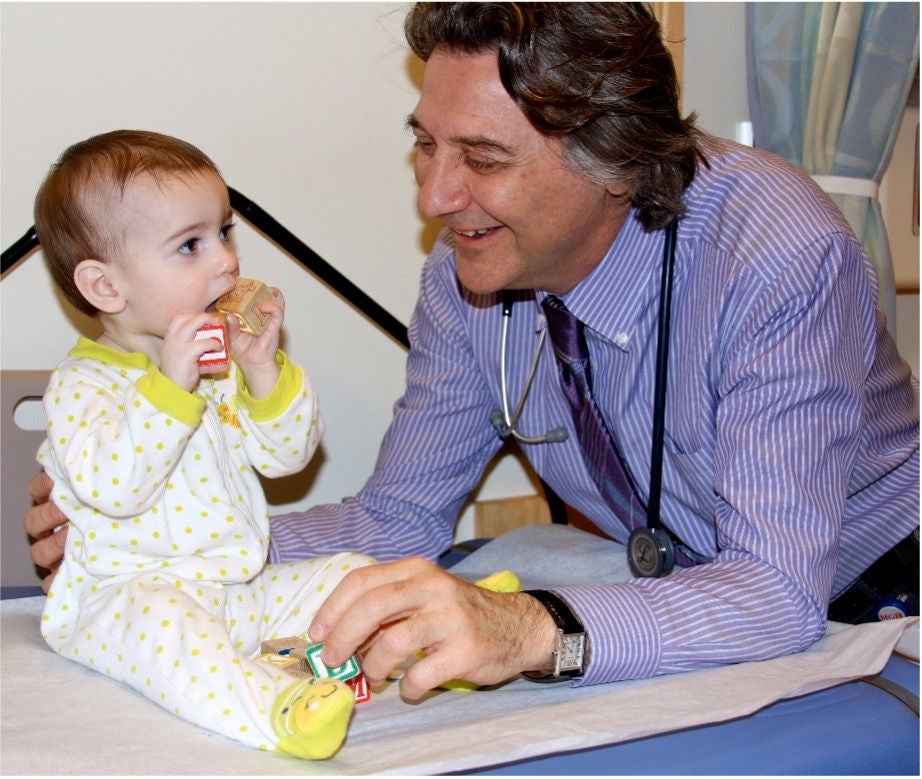
Alessio Fasano, MD, with a patient