MGH Rheumatology Fellowship
Email: lbaino@mgh.harvard.edu
Overview
Welcome to the Rheumatology Fellowship Program at Massachusetts General Hospital!
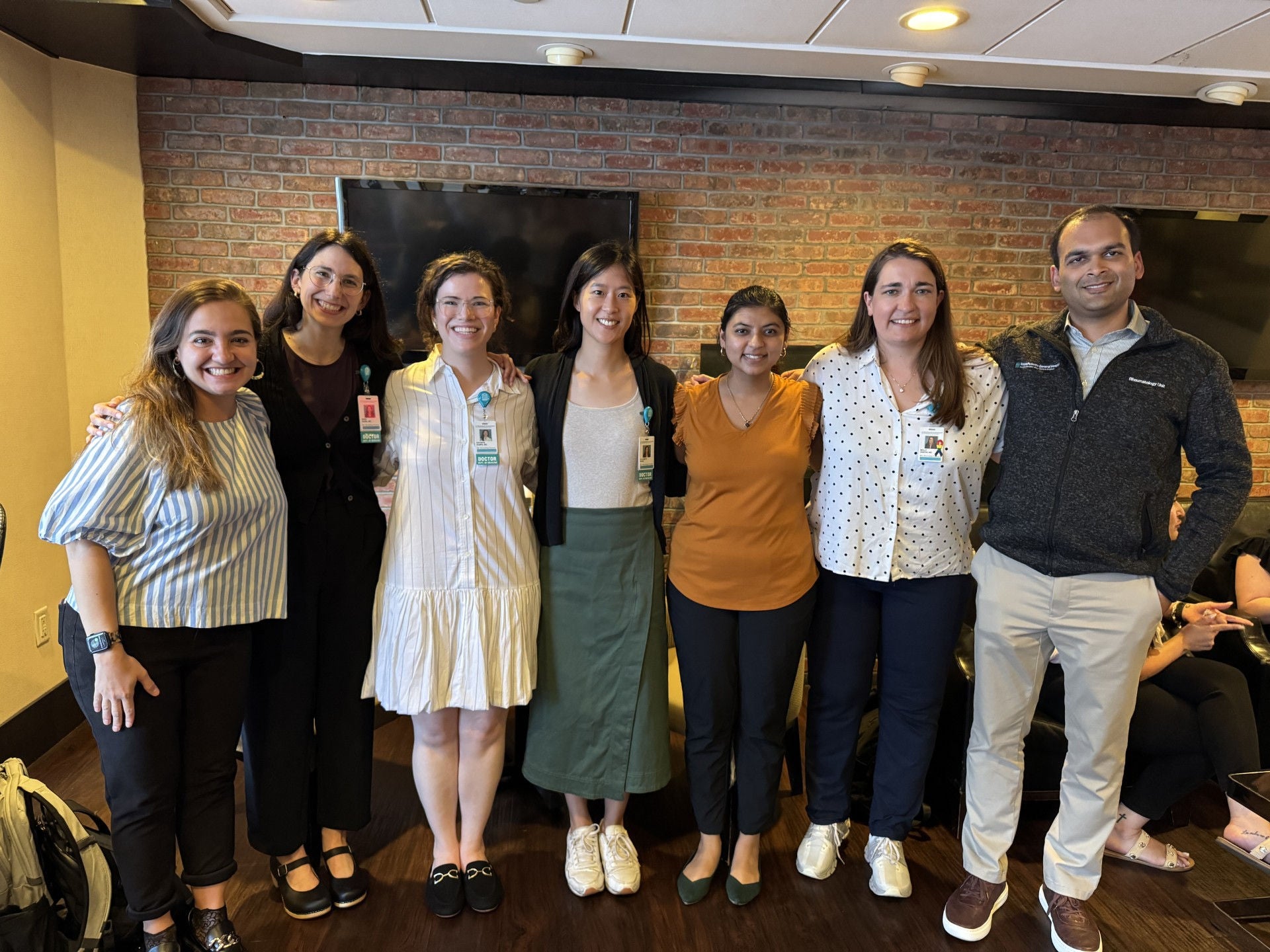
We are committed to training exceptional clinicians, future leaders and life-long learners who provide expert, compassionate care to patients across the full spectrum of rheumatic disease. Our faculty are deeply committed to education and mentorship, and our fellows bring diverse interests while sharing a passion for learning, patient care, and supporting each other.
The inpatient consult service and outpatient clinics form the core of our program and are supplemented by a comprehensive didactic curriculum. Two fellows work side by side on the consult service promoting teamwork, sharing of ideas and learning together. Working closely with our expert faculty and collaborating with specialists from other disciplines, fellows take the lead in caring for patients with both common and complex conditions.
Career development is a central focus of what we do. Our faculty are internationally recognized leaders in basic and translational science, clinical trials and clinical epidemiology who support fellows’ growth as investigators. Training clinician educators is another core mission. Our fellows play a vital role in teaching and mentoring medical students and residents and have the opportunity to participate in a longitudinal Medical Educator Program for Fellows in their second year.
Mentorship is a key strength of our division. Our faculty are deeply invested in fellows’ success and provide longitudinal support throughout training and beyond. We emphasize thoughtful and structured mentorship that evolves with fellows’ interests across the clinical, research, leadership and education domains.
This is an exciting time in the Mass General Brigham Division of Rheumatology, Inflammation and Immunity. With an integrated division of rheumatology, fellows have access to research and education opportunities at both MGH and BWH. For this recruitment cycle our programs will remain separate while we continue to develop the integrated rheumatology fellowship training program.
Thank you for your interest in learning about our training program.
Warm regards,
Eli Miloslavsky
Fellowship Program Director
MGH Rheumatology
Requirements
- MDs who have completed three years of post-graduate training in internal medicine (or two years under the ACGME research residency)
- Board eligible in Internal Medicine
- USMLE Steps I, II, and III passed
Program Details
We offer both an ACGME-accredited 2-year clinical pathway comprising one clinical and one clinical/research year and the 3-year NIH-sponsored track with 2 years of research.
Inpatient Consultation Experience
First-year fellows see inpatient rheumatology consultations at MGH and the Mass Eye and Ear Infirmary in two-week rotations spanning approximately half of the first year. Two fellows are on the consult service together to support camaraderie, learning, teamwork and wellness. Fellows work closely with the internal medicine residents and medical students who are rotating on the rheumatology service.
MGH is a general hospital committed to the care of the communities we serve as well as a tertiary referral and quaternary care center long recognized as an international leader in patient care. Therefore, there is exceptional diversity in the patients for whom our fellows provide care, including common rheumatic conditions as well as rare and difficult cases. This diversity and complexity are represented in the Case Records published in the New England Journal of Medicine. In addition to the MGH rotations, each fellow spends two weeks on the rheumatology consultation service at the Brigham and Women’s Hospital.
Second-year fellows spend one to two 2-week blocks on the inpatient rheumatology consult service.
Outpatient Experience
Rheumatology is primarily an outpatient specialty, and our outpatient training is a core strength of our program. Each year, the faculty and fellows see over 12,000 patients in the MGH outpatient practice. Fellows follow patients longitudinally and serve as the patient’s primary rheumatologist, including for patients referred for subspecialty care in one of our clinical focus areas (e.g. lupus, vasculitis, scleroderma, IgG4- related disease, and others). First-year fellows have a weekly half-day continuity clinic while on the inpatient consult service and 4 half-days of continuity clinic per week on the “outpatient fellow” rotation, including rotating through the subspecialty clinics in Musculoskeletal Ultrasound, IgG4-related disease, Rheumatology/Dermatology, and Osteoporosis clinics. Fellows work with a longitudinal preceptor in each of their clinics for the entire year to foster teaching, continuity of care, and mentorship.
Second-year fellows have one to four half-day clinics per week depending on whether they are pursuing the research or clinical pathways. In addition to continuity clinic, outpatient subspecialty clinics are tailored to fellows’ evolving clinical interests in their second year. Fellows can focus on ultrasound training, have an expanded experience in one of our clinical focus areas or rotate in other specialties including pulmonary, neurology, dermatology, orthopedics or sports medicine. In addition, fellows have a four-session exposure to pediatric rheumatology in the Mass General Pediatric Rheumatology Outpatient Clinic.
Ultrasound training
All fellows train in the basics of musculoskeletal ultrasound by rotating in ultrasound clinic and through a one-year ultrasound curriculum led by our internationally recognized musculoskeletal ultrasound faculty. Fellows with a strong interest in developing their rheumatology ultrasound skills have an ultrasound continuity clinic in their second year and some pursue ultrasound certification through USSONAR.

The MGB Division of Rheumatology, Inflammation and Immunity faculty have tremendous expertise across basic and translational science, clinical epidemiology and outcomes as well as in clinical trials and medical education scholarship. Fellows have the opportunity to work with faculty at MGH or BWH during their training. Fellows are encouraged to explore their research interests during the first year through structured elements such as “Meet the Faculty”, “Introduction to Research” and clinical research meetings in research centers such as the Center for Immunology and Inflammatory Diseases and the Mongan Institute among others. As fellows start to define their research interests, dedicated mentors work with fellows to design a project proposal in the second half of their first year of training.
Second-year fellows have a strong focus on research training, and although only two years of training are required by the ACGME, many fellows at MGH elect to train for three or more years in order to enrich their research training component. Fellows, with a commitment to research training, spend less time in the outpatient clinic and on the inpatient consult service during their second year of training : one to two half days of continuity clinic per week and two to four weeks per year on the Consult Service. The amount of time spent in the outpatient clinic and on the inpatient consult service is tailored to individual educational needs based on the fellow’s research interests; those involved in bench science research will spend less time in the clinical setting whereas those involved in clinical research will have more outpatient exposure with an emphasis on patients in clinic with the disease process being studied.
Many fellows pursue additional research training opportunities in their second and third years including the Summer Program in Clinical Effectiveness or the summer-only program in Master of Science in Epidemiology, or summer-only program in Master of Public Health. These programs are designed for individuals interested in careers in clinical epidemiology research or quantitative aspects of public health.
Fellows interested in careers in medical education have the opportunity to participate in the Medical Educator Program for Fellows in their second year of training.
Our comprehensive curriculum spans the breadth of the field over a two-year cycle, covering fundamental topics, emerging concepts, immunology and research methodology to prepare our fellows to be life-long learners and to be well-equipped to engage with emerging science throughout their careers.
Our curriculum emphasizes active learning and case-based discussions leveraging the deep expertise of the MGH faculty.
Conference Types
- Rheumatology Grand Rounds
Weekly conference where faculty members from MGH or other nationally or internationally recognized speakers discuss important and emerging topics in rheumatology. - Case Conference
Each rheumatology fellow has the opportunity to give this conference. The fellow leads the audience through two cases, facilitating a group discussion on the challenging aspects of the case. - Journal Club
Monthly conference led by fellows and mentored by a faculty member. Each Journal Club involves the discussion of two journal articles, selected by a faculty member focusing on critical appraisal and application to care paradigms (one recent and one related landmark article). - Radiology Conference
Monthly conference with the goal of teaching fellows about the interpretation of imaging, focusing on arthritis and musculoskeletal diseases. - Pathology Conference
Held four times per year this conference is focused on discussing pathology findings from challenging clinical cases, led by Dr. James Stone, an internationally recognized pathologist. - Mills Rounds
Named in honor of John Mills, MD, a master clinician, this conference is held three to four times per year. Faculty present difficult cases from their most recent inpatient consult block facilitating group discussion and input on further care. - Patient Care Conference
Held four times per year this format enables fellows and faculty to bring short questions about practice approaches for group discussion. This is a great opportunity for fellows to see the variation in physician practices. - Rheumatology Faculty Research Conference
Faculty Research Conference occurs three to four times per year. The presentations are given by Rheumatology faculty members related to their ongoing research interests and discoveries. - Interhospital Rounds
This hybrid evening conference, held six times per year, brings together Boston area rheumatology fellowship training programs. Fellows from the hosting hospital present cases reflecting some of most difficult diagnostic challenges and unusual disease presentations. - Medical Grand Rounds
Once weekly conference organized by the Department of Medicine highlighting internationally recognized experts.
Fellow-only conferences
- Jorge Journal Club
Directed by Dr. April Jorge, this twice monthly conferences focus on rapid review of abstracts from important articles in current issues of high impact journals in rheumatology. - Fellows’ Report
The clinical fellows meet monthly with two faculty members to discuss challenging active cases from the inpatient or outpatient services in an informal setting. - Musculoskeletal Ultrasound Conference
Musculoskeletal Ultrasound (MSUS) Conference is held six times per year and is led by Drs. Minna Kohler, Mark Matza, and Janeth Yinh. The conference is focused on distinguishing indications for MSUS, basic hands-on scanning techniques and image interpretation. - Meet the Faculty
Informal breakfasts where a faculty member discusses their career trajectory with fellows. These sessions are designed to help fellows get to know the breadth of faculty work, mentorship, and scholarship in our division. - Bread ‘N Butter Conference
Once monthly fellow-only conference focusing on topics not covered in other aspects of the curriculum.
Opportunities to enhance your teaching skills and launch a career as a medical educator are an important part of our program. All fellows participate in the Fellow as Clinical Teacher (FACT) curriculum and teach medical students and residents who rotate on the inpatient consult service. In addition, all fellows have the opportunity to lead one Noon Conference in the North Shore Medical Center IM residency program and lead other didactic experiences at Harvard Medical School or within the MGH Internal Medicine residency program. Direct observation and feedback on fellow teaching skills by expert rheumatology educator faculty during these experiences facilitates deliberate feedback.
Fellows planning to pursue a career as a clinician educator can participate in the DOM-wide Medical Educator Program for Fellows in their second year of training where they gain a deep understanding of fundamental and advanced concepts in medical education and engage in deliberate practice of teaching across multiple settings.
How to Apply
Applications are processed through the Electronic Residency Application Service (ERAS). For administrative questions, contact Fellowship Coordinator Lauren Baino (lbaino@partners.org).
Apply via ERAS
Apply for Rheumatology Fellowship
Mark Matza, MD – Clinical Director of Rheumatology
Belen Arevalo, MD – Associate Program Director
Ellen Gravallese, MD – Division Chief
Lauren Baino – Fellowship Coordinator (lbaino@partners.org)
Rheumatology Clinical Research
Rheumatology Clinical Research